Banco de preguntas CCNA 200-301 actualizado 16 de marzo 2026
Si ya estudiaste para tu examen de certificación y crees que dominas todos los temas, solo te queda practicar y practicar. Ponemos a tu disposición el banco de preguntas oficial. Respondiendo a estas preguntas, ten la certeza que conseguirás la certificación. Este banco de preguntas se actualiza de manera periódica.
NOTA: Si eres estudiante de nuestro curso de CCNA, automáticamente tienes acceso a este material.
1581 preguntas Incluyen preguntas de configuración
Soporte incluido para cualquier duda que tengas
Precio de 30 USD/Mes
Preguntas
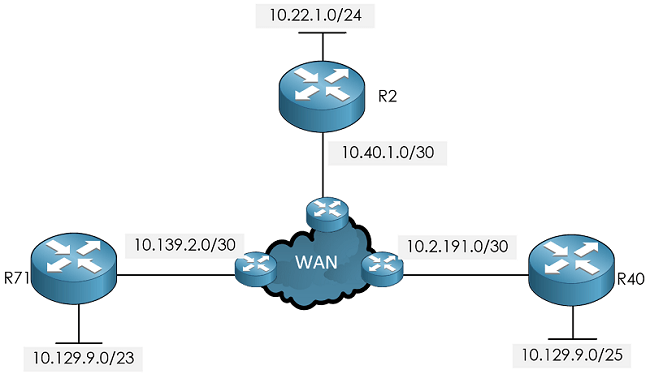
1. Refer to the exhibit. All routers in the network are configured correctly, and the expected routes are being exchanged among the routers. Which set of routes are learned from neighbors and installed on router 2?
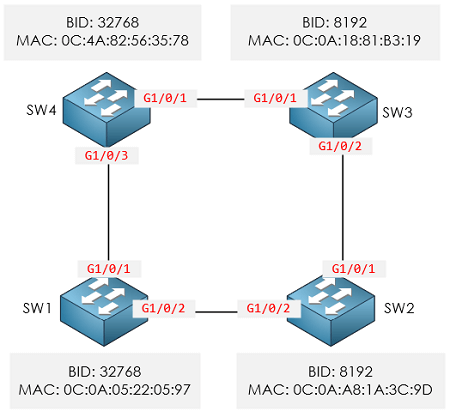
2. Refer to the exhibit. Which switch in this configuration will be elected as the root bridge?
A. SW1 B. SW2 C. SW3 D. SW4
3. Which two REST API status-code classes represent errors? (Choose two)
A. 1XX B. 2XX C. 3XX D. 4XX E. 5XX
4. Refer to the exhibit. Router R2 is configured with multiple routes to reach network 10.1.1.0/24 from router R1. Which path is chosen by router R2 to reach the destination network 10.1.1.0/24?
5. What are two benefits that the UDP protocol provide for application traffic? (Choose two.)
A. UDP traffic has lower overhead than TCP traffic B. UDP provides a built-in recovery mechanism to retransmit lost packets C. The CTL field in the UDP packet header enables a three-way handshake to establish the connection D. UDP maintains the connection state to provide more stable connections than TCP E. The application can use checksums to verify the integrity of application data
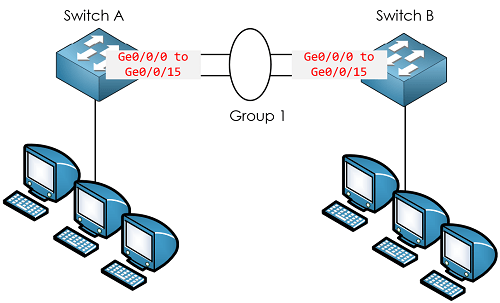
6. Refer to the exhibit. The LACP EtherChannel is configured, and the last change is to modify the interfaces on SwitchA to respond to packets received, but not to initiate negotiation. The interface range gigabitethernet0/0/0-15 command is entered. What must be configured next?
A. SwitchA(config-if-range)#channel-group 1 mode auto B. SwitchA(config-if-range)#channel-group 1 mode active C. SwitchA(config-if-range)#channel-group 1 mode desirable D. SwitchA(config-if-range)#channel-group 1 mode passive
7. Refer to the exhibit. How will the device handle a packet destined to IP address 100.100.100.100?
100.0.0.0/8 is variably subnetted, 4 subnets, 4 masks
R    100.0.0.0/8 [120/2] via 192.168.3.1, 00:00:13, Ethernet0/3
S    100.100.0.0/16 [1/0] via 192.168.4.1
D   100.100.100.0/24 [90/435200] via 192.168.2.1, 00:00:13, Ethernet0/2
O   100.100.100.100/32 [110/21] via 192.168.1.1, 00:05:57, Ethernet0/1
A. It will always prefer the static route over dynamic routes and choose the route S 100.100.0.0/16 [1/0] via 192.168.4.1 B. It will choose the route with the lowest metric, R 100.0.0.0/8 [120/2] via 192.168.3.1, 00:00:13, Ethernet0/3 C. It will choose the route with the highest metric, D 100.100.100.0/24 [90/435200] via 192.168.2.1, 00:00:13, Ethernet0/2 D. It will choose the route with the longest match, O 100.100.100.100/32 [110/21] via 192.168.1.1, 00:05:57, Ethernet0/1.
8. A network engineer is configuring a new router at a branch office. The router is connected to an upstream WAN network that allows the branch to communicate with the head office. The central time server with IP address 172.24.54.8 is located behind a firewall at the head office. Which command must the engineer configure so that the software clock of the new router synchronizes with the time server?
A. ntp server 172.24.54.8 B. ntp master 172.24.54.8 C. ntp peer 172.24.54.8 D. ntp client 172.24.54.8
9. What is the RFC 4627 default encoding for JSON text? (Choose two.)
A. UCS-2 B. GB18030 C. UTF-8 D. Hex
10. Refer to the exhibit. What is the cause of poor performance on router R19? (Choose two.)
R19#sh int fa0/0
FastEthernet0/0 is up, line protocol is up
Hardware is DEC21140, address is ca02.7788.0000 (bia ca02.7788.0000) Description: SALES_SUBNET
Internet address is 10.32.102.2/30
MTU 1500 bytes, BW 100000 kbit/sec, DLY 100 usec, reliability 255/255, txload 1/255, rxload 1/255
Encapsulation ARPA, loopback not set
Keepalive set (60 sec)
Full-duplex, 100Mb/s, 100BaseTX/FX
ARP type: ARPA, ARP Timeout 04:00:00
Last input 00:00:01, output 00:00:00, output hang never Last clearing of "show interface" counters never
Input queue: 0/300/0/0 (size/max/drops/flushes); Total output drops: 135298429
Queueing strategy: fifo
Output queue: 0/300 (size/max)
30 second input rate 0 bits/sec, 0 packets/sec 30 second output rate 0 bits/sec, 0 packets/sec 73310 packets input, 7101162 bytes
Received 73115 broadcasts (0 IP multicasts) 0 runts, 0 giants, 0 throttles
0 input errors, 4 CRC, 0 frame, 0 overrun, 0 ignored
0 watchdog
0 input packets with dribble condition detected
3927513096455 packets output, 14404034810952 bytes, 0 underruns
0 output errors, 11 collisions, 0 interface resets
0 unknown protocol drops
0 babbles, 0 late collision, 0 deferred
0 lost carrier, 0 no carrier
0 output buffer failures, 0 output buffers swapped out
A. Excessive collisions B. Excessive CRC errors C. Port oversubscription
Hello Alvaro, in Question 860. why not select option «D. The next hop is 10.0.0.1 because it has a better administrative distance» over option «C. The next hop is 10.0.2.1 because it is a link-state routing protocol», and when you write «(Pregunta fuera del blueprint» are you talking about the CCNA curriculum?. Thank you in advance.
You are right; it’s D. At first, you might think it isn’t D because of the ‘Redistribution Between EIGRP and OSPF. When EIGRP routes are redistributed, they are assigned an AD of 170. This AD would be higher than the OSPF routes AD of 110. However, in this case, we have the SAME EIGRP AS in router B (100). This means that NO redistribution is happening between the EIGRP routes.
In conclusion, router D sees an AD of 110 using router C and an AD of 90 using router B, with a next hop of 10.0.0.1.
Regarding your other question, yes, this topic of «Redistribution» is not detailed in the CCNA curriculum.
Hi, by chance don’t you have the PKTs files (templates with the necessary pre-configuration) for these Labs and simulations?
#734 (LAB)
#673 (LAB)
#672 (LAB)
#671 (LAB)
#670 (LAB)
#656 (LAB)
#646 (simulator)
#645 (simulator)
#644 (simulator)
#638 (simulator)
Quiero pronto adquirir el boucher para el examen CCNA, pero entiendo que al parecer ya no se hace por PEARSON VUE ¿o me equivoco?
La otra consulta es respecto al cambio de currícula ¿Hasta cuándo tengo plazo para dar el examen CCNA 200-301?
Hola Gabriel, Pearson VUE sigue siendo la empresa encargada para rendir el examen CCNA, ya sea de manera física a través de un Test Center, o de manera online a través de OnVUE.
Respecto a tu segunda consulta, no existen plazos para rendir el examen CCNA 200-301, NO existe un cambio de curricula anunciado por Cisco, así que por el momento no hay novedades respecto a este tema, los mismos temas desde el 2020 se siguen manteniendo vigentes hasta la fecha. De existir cambios los publicaremos acá para que los tengan en cuenta.