Banco de preguntas CCNA 200-301 actualizado 16 de marzo 2026
Si ya estudiaste para tu examen de certificación y crees que dominas todos los temas, solo te queda practicar y practicar. Ponemos a tu disposición el banco de preguntas oficial. Respondiendo a estas preguntas, ten la certeza que conseguirás la certificación. Este banco de preguntas se actualiza de manera periódica.
NOTA: Si eres estudiante de nuestro curso de CCNA, automáticamente tienes acceso a este material.
1581 preguntas Incluyen preguntas de configuración
Soporte incluido para cualquier duda que tengas
Precio de 30 USD/Mes
Preguntas
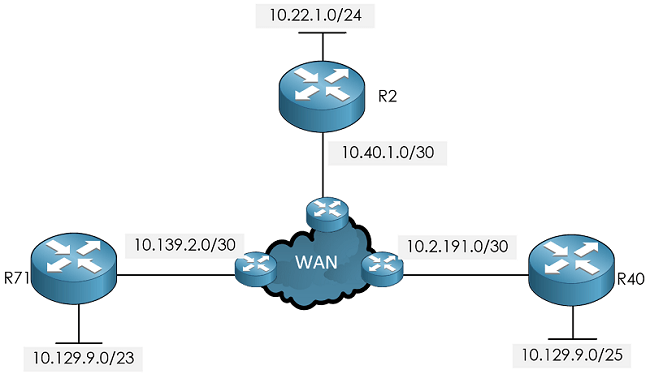
1. Refer to the exhibit. All routers in the network are configured correctly, and the expected routes are being exchanged among the routers. Which set of routes are learned from neighbors and installed on router 2?
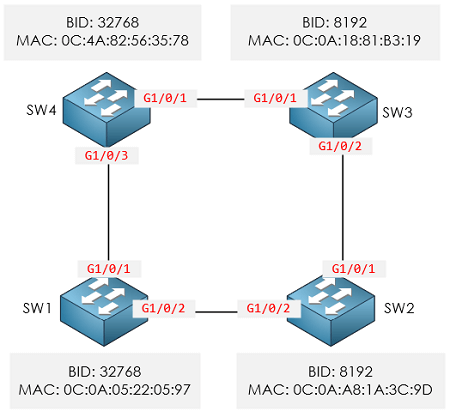
2. Refer to the exhibit. Which switch in this configuration will be elected as the root bridge?
A. SW1 B. SW2 C. SW3 D. SW4
3. Which two REST API status-code classes represent errors? (Choose two)
A. 1XX B. 2XX C. 3XX D. 4XX E. 5XX
4. Refer to the exhibit. Router R2 is configured with multiple routes to reach network 10.1.1.0/24 from router R1. Which path is chosen by router R2 to reach the destination network 10.1.1.0/24?
5. What are two benefits that the UDP protocol provide for application traffic? (Choose two.)
A. UDP traffic has lower overhead than TCP traffic B. UDP provides a built-in recovery mechanism to retransmit lost packets C. The CTL field in the UDP packet header enables a three-way handshake to establish the connection D. UDP maintains the connection state to provide more stable connections than TCP E. The application can use checksums to verify the integrity of application data
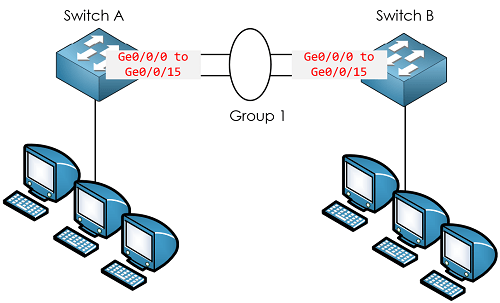
6. Refer to the exhibit. The LACP EtherChannel is configured, and the last change is to modify the interfaces on SwitchA to respond to packets received, but not to initiate negotiation. The interface range gigabitethernet0/0/0-15 command is entered. What must be configured next?
A. SwitchA(config-if-range)#channel-group 1 mode auto B. SwitchA(config-if-range)#channel-group 1 mode active C. SwitchA(config-if-range)#channel-group 1 mode desirable D. SwitchA(config-if-range)#channel-group 1 mode passive
7. Refer to the exhibit. How will the device handle a packet destined to IP address 100.100.100.100?
100.0.0.0/8 is variably subnetted, 4 subnets, 4 masks
R    100.0.0.0/8 [120/2] via 192.168.3.1, 00:00:13, Ethernet0/3
S    100.100.0.0/16 [1/0] via 192.168.4.1
D   100.100.100.0/24 [90/435200] via 192.168.2.1, 00:00:13, Ethernet0/2
O   100.100.100.100/32 [110/21] via 192.168.1.1, 00:05:57, Ethernet0/1
A. It will always prefer the static route over dynamic routes and choose the route S 100.100.0.0/16 [1/0] via 192.168.4.1 B. It will choose the route with the lowest metric, R 100.0.0.0/8 [120/2] via 192.168.3.1, 00:00:13, Ethernet0/3 C. It will choose the route with the highest metric, D 100.100.100.0/24 [90/435200] via 192.168.2.1, 00:00:13, Ethernet0/2 D. It will choose the route with the longest match, O 100.100.100.100/32 [110/21] via 192.168.1.1, 00:05:57, Ethernet0/1.
8. A network engineer is configuring a new router at a branch office. The router is connected to an upstream WAN network that allows the branch to communicate with the head office. The central time server with IP address 172.24.54.8 is located behind a firewall at the head office. Which command must the engineer configure so that the software clock of the new router synchronizes with the time server?
A. ntp server 172.24.54.8 B. ntp master 172.24.54.8 C. ntp peer 172.24.54.8 D. ntp client 172.24.54.8
9. What is the RFC 4627 default encoding for JSON text? (Choose two.)
A. UCS-2 B. GB18030 C. UTF-8 D. Hex
10. Refer to the exhibit. What is the cause of poor performance on router R19? (Choose two.)
R19#sh int fa0/0
FastEthernet0/0 is up, line protocol is up
Hardware is DEC21140, address is ca02.7788.0000 (bia ca02.7788.0000) Description: SALES_SUBNET
Internet address is 10.32.102.2/30
MTU 1500 bytes, BW 100000 kbit/sec, DLY 100 usec, reliability 255/255, txload 1/255, rxload 1/255
Encapsulation ARPA, loopback not set
Keepalive set (60 sec)
Full-duplex, 100Mb/s, 100BaseTX/FX
ARP type: ARPA, ARP Timeout 04:00:00
Last input 00:00:01, output 00:00:00, output hang never Last clearing of "show interface" counters never
Input queue: 0/300/0/0 (size/max/drops/flushes); Total output drops: 135298429
Queueing strategy: fifo
Output queue: 0/300 (size/max)
30 second input rate 0 bits/sec, 0 packets/sec 30 second output rate 0 bits/sec, 0 packets/sec 73310 packets input, 7101162 bytes
Received 73115 broadcasts (0 IP multicasts) 0 runts, 0 giants, 0 throttles
0 input errors, 4 CRC, 0 frame, 0 overrun, 0 ignored
0 watchdog
0 input packets with dribble condition detected
3927513096455 packets output, 14404034810952 bytes, 0 underruns
0 output errors, 11 collisions, 0 interface resets
0 unknown protocol drops
0 babbles, 0 late collision, 0 deferred
0 lost carrier, 0 no carrier
0 output buffer failures, 0 output buffers swapped out
A. Excessive collisions B. Excessive CRC errors C. Port oversubscription
Son 16 subredes que se obtienen. Acá lastimosamente no sabemos cuál de las 2 formas escoge Cisco para el examen, podríamos tomar una forma de numeración donde comenzamos desde la subred 0 hasta la subred 15, o de la segunda forma donde directamente tomamos a la 172.16.0.0/20 como la primera subred; en este segundo caso tendríamos como segunda subred a la 172.16.16.0/20 que es la que se elige como respuesta correcta. Si sigues la nomenclatura de tomar a subred 172.16.0.0/20 como la subred 0, obviamente la selección cambiaría, y tendríamos que trabajar con la subred 172.16.32.0/20 como la segunda subred. No puedo darte una respuesta 100% correcta, ya que no sabemos cómo está pensada la pregunta, lastimosamente tendrás que lanzarte por una u otra opción; también existe la posibilidad que la pregunta se encuentre incompleta, y en realidad sí te den algún tipo de aviso sobre que forma de numeración tomar.
Atentos a tus comentarios.
Saludos! =)
Esta respuesta fue modificada hace 2 años, 1 mes por AlvaroM.
Refer to the exhibit. An engineer configured NAT translations and has verified that the configuration is correct. Which IP address is the source IP after the NAT has taken place?
Me podrias explicar, lo tome en referencia a responder la IP del outside como si preguntara de la source que viene a buscar la IP que esta en NAT.
Hola, un apoyo con la pregunta 49. ¿ Porqué es la D? el eBGP instala el path con 20 AD, por lo cual debería cambiar la ruta en la tabla de enrutamiento.
En este caso te indican cual es la IP «después del nateo», por lo tanto, de acuerdo a terminología de NAT, la Inside local es la IP original del dispositivo cliente, y la Inside Global, es la IP que se le asigna al dispositivo cliente (dirección de origen) una vez se completa el proceso de Nateo, con esa IP de origen viajara el paquete hacia Internet. De acuerdo a la tabla, puedes ver que nos dan el valor de Inside Global equivalente a 172.23.104.4, este valor se encuentra entre las opciones y por ello se la toma como opción correcta.
Hola estimado Alvaron una consulta. Para esta pregunta
Which command automatically generates an IPv6 address from a specified Ipv6 prefix and MAC address of an interface?
Al estarse refiriendo a un prefijo IPV6 especifico ¿la respuesta no seria la que incluye el IPV6 address XXXXX/64 Eui?. Por que entiendo de acuerdo a la pregunta que seria hacia un prefijo especifico. Si es uno que ya se aprendiera por la conexión si me pareceria mas correcto la de IPv6 autoconfig.
Respecto a la pregunta 49, la respuesta que tiene mas sentido es la C, sin embargo hay cierta interpretación sobre que no podemos estar 100% seguros ya que no vemos la configuración de BGP. De todas formas hemos corregido la respuesta.
Hola Wilmer, respecto a la pregunta 10, la opción correcta es B ya que se está solicitando una dirección IPv6 especificando un prefijo y una dirección MAC. Respecto a la pregunta inalámbrica, es correcto, el algoritmo es AS128; y finalmente respecto al último comentario, ya se introdujo las interfaces correctas.
una pregunta, actualmente en el examen de certificación hay simulación para configurar?? si alguien del foro hizo el examen hace poco, si los hay cuantos vienen?
Hola Bryith, efectivamente te vas a pillar preguntas de simulación, por lo menos 3 (a no ser que algo haya cambiado en las últimas semanas, cosa que veo improbable). Recuerda que tienes estas preguntas en el banco de preguntas.
tengo una duda en la pregunta 1211. Which protocol must be implemented to support separate authorization and authentication solutions for wireless APs?
no es TACACS+ la respuesta correcta