Banco de preguntas CCNA 200-301 actualizado 16 de marzo 2026
Si ya estudiaste para tu examen de certificación y crees que dominas todos los temas, solo te queda practicar y practicar. Ponemos a tu disposición el banco de preguntas oficial. Respondiendo a estas preguntas, ten la certeza que conseguirás la certificación. Este banco de preguntas se actualiza de manera periódica.
NOTA: Si eres estudiante de nuestro curso de CCNA, automáticamente tienes acceso a este material.
1581 preguntas Incluyen preguntas de configuración
Soporte incluido para cualquier duda que tengas
Precio de 30 USD/Mes
Preguntas
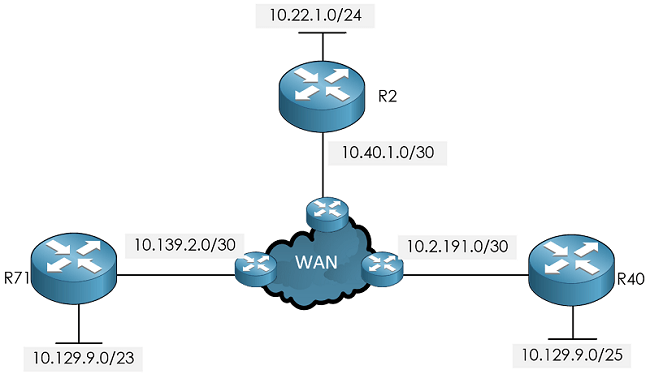
1. Refer to the exhibit. All routers in the network are configured correctly, and the expected routes are being exchanged among the routers. Which set of routes are learned from neighbors and installed on router 2?
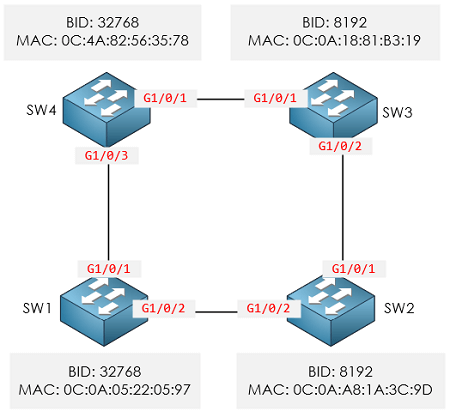
2. Refer to the exhibit. Which switch in this configuration will be elected as the root bridge?
A. SW1 B. SW2 C. SW3 D. SW4
3. Which two REST API status-code classes represent errors? (Choose two)
A. 1XX B. 2XX C. 3XX D. 4XX E. 5XX
4. Refer to the exhibit. Router R2 is configured with multiple routes to reach network 10.1.1.0/24 from router R1. Which path is chosen by router R2 to reach the destination network 10.1.1.0/24?
5. What are two benefits that the UDP protocol provide for application traffic? (Choose two.)
A. UDP traffic has lower overhead than TCP traffic B. UDP provides a built-in recovery mechanism to retransmit lost packets C. The CTL field in the UDP packet header enables a three-way handshake to establish the connection D. UDP maintains the connection state to provide more stable connections than TCP E. The application can use checksums to verify the integrity of application data
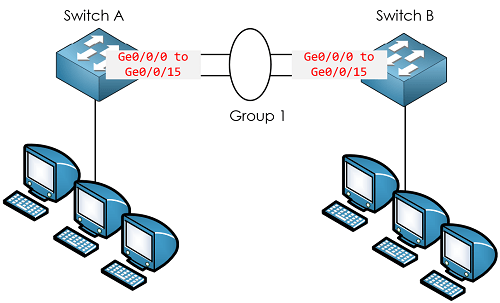
6. Refer to the exhibit. The LACP EtherChannel is configured, and the last change is to modify the interfaces on SwitchA to respond to packets received, but not to initiate negotiation. The interface range gigabitethernet0/0/0-15 command is entered. What must be configured next?
A. SwitchA(config-if-range)#channel-group 1 mode auto B. SwitchA(config-if-range)#channel-group 1 mode active C. SwitchA(config-if-range)#channel-group 1 mode desirable D. SwitchA(config-if-range)#channel-group 1 mode passive
7. Refer to the exhibit. How will the device handle a packet destined to IP address 100.100.100.100?
100.0.0.0/8 is variably subnetted, 4 subnets, 4 masks
R    100.0.0.0/8 [120/2] via 192.168.3.1, 00:00:13, Ethernet0/3
S    100.100.0.0/16 [1/0] via 192.168.4.1
D   100.100.100.0/24 [90/435200] via 192.168.2.1, 00:00:13, Ethernet0/2
O   100.100.100.100/32 [110/21] via 192.168.1.1, 00:05:57, Ethernet0/1
A. It will always prefer the static route over dynamic routes and choose the route S 100.100.0.0/16 [1/0] via 192.168.4.1 B. It will choose the route with the lowest metric, R 100.0.0.0/8 [120/2] via 192.168.3.1, 00:00:13, Ethernet0/3 C. It will choose the route with the highest metric, D 100.100.100.0/24 [90/435200] via 192.168.2.1, 00:00:13, Ethernet0/2 D. It will choose the route with the longest match, O 100.100.100.100/32 [110/21] via 192.168.1.1, 00:05:57, Ethernet0/1.
8. A network engineer is configuring a new router at a branch office. The router is connected to an upstream WAN network that allows the branch to communicate with the head office. The central time server with IP address 172.24.54.8 is located behind a firewall at the head office. Which command must the engineer configure so that the software clock of the new router synchronizes with the time server?
A. ntp server 172.24.54.8 B. ntp master 172.24.54.8 C. ntp peer 172.24.54.8 D. ntp client 172.24.54.8
9. What is the RFC 4627 default encoding for JSON text? (Choose two.)
A. UCS-2 B. GB18030 C. UTF-8 D. Hex
10. Refer to the exhibit. What is the cause of poor performance on router R19? (Choose two.)
R19#sh int fa0/0
FastEthernet0/0 is up, line protocol is up
Hardware is DEC21140, address is ca02.7788.0000 (bia ca02.7788.0000) Description: SALES_SUBNET
Internet address is 10.32.102.2/30
MTU 1500 bytes, BW 100000 kbit/sec, DLY 100 usec, reliability 255/255, txload 1/255, rxload 1/255
Encapsulation ARPA, loopback not set
Keepalive set (60 sec)
Full-duplex, 100Mb/s, 100BaseTX/FX
ARP type: ARPA, ARP Timeout 04:00:00
Last input 00:00:01, output 00:00:00, output hang never Last clearing of "show interface" counters never
Input queue: 0/300/0/0 (size/max/drops/flushes); Total output drops: 135298429
Queueing strategy: fifo
Output queue: 0/300 (size/max)
30 second input rate 0 bits/sec, 0 packets/sec 30 second output rate 0 bits/sec, 0 packets/sec 73310 packets input, 7101162 bytes
Received 73115 broadcasts (0 IP multicasts) 0 runts, 0 giants, 0 throttles
0 input errors, 4 CRC, 0 frame, 0 overrun, 0 ignored
0 watchdog
0 input packets with dribble condition detected
3927513096455 packets output, 14404034810952 bytes, 0 underruns
0 output errors, 11 collisions, 0 interface resets
0 unknown protocol drops
0 babbles, 0 late collision, 0 deferred
0 lost carrier, 0 no carrier
0 output buffer failures, 0 output buffers swapped out
A. Excessive collisions B. Excessive CRC errors C. Port oversubscription
Tambien quisiera preguntarle, hay un laboratorio, pregunta 672 que escoge un channel-group 44. A que se debe eso? Desde que rango a que rango se puede escocger esta eleccion?
Vale acabo de ver que te lo da el problema el channel-group. Pero en caso de que no te lo diese, que rango de canales se escocge? he visto que es entre 1-64en switches catalyst pero en packet tracer que varia de 1-16 y de 1-32
Respecto a la 1008 es simplemente un error de imagen, en realidad debería ser 8192, ya hemos corregido la imagen.
Y respecto a la 672, si el enunciado no te lo dice, tendrías que analizar la configuración de los switches vecinos de existir alguno, y utilizar ese número. Si por el contrario es creación de un etherchannel desde 0 y no hay directivas, pues no debería existir problema en elegir el número 1 ya que está disponible en ambos switches.
Acabo de terminar hoy (11/07/2024) el examen de CCNA. Cuanto a las preguntas, han sido 86 de las cuales tres eran laboratorios. Uno ha sido parecido al de ospf que esta en el banco de preguntas, el otro parecido a la pregunta 1113 0 1166 y la ultima parecida parecida tambien a la pregunta 1271. Tambien comentar, que las preguntas tipo test, estan todas en el banco de preguntas. Solo vi una que no la habia visto que era al de RC 4861. No recuerdo mas.
Por suerte, aprobe el examen. No se cual ha sido la nota ya que solo pone PASS.
Os deseo mucha suerte a todos. Ahora un pequeño descanso e ire a por el CCNP.
Logro bien merecido. Muchísimas gracias por los inputs otorgados sobre el examen, que seguramente serán más que valiosos para tus compañeros. Respecto a tu consulta, sí, debes esperar un par de días a que Cisco «formalmente» apruebe tu nota. En el transcurso de los días te llegara un correo con los siguientes pasos a seguir, y ahí recién podrías descargar tu certificado digital de CCNA. ¡Nuevamente felicidades y a seguir con el CCNP! =D
me podrias explicar por la pregunta 946 es la B, no podria ser la C
946. What is a function of the core and distribution layers in a collapsed-core architecture?
A. The router can support HSRP for Layer 2 redundancy in an IPv6 network
B. The core and distribution layers are deployed on two different devices to enable failover
C. The router operates on a single device or a redundant pair
D. The router must use IPv4 and IPv6 addresses at Layer 3.
En la 721 creo que las respuestas serian la A y la C
It enables traffic filtering based on URLs
It provides support as an endpoint for a remote access VPN in multiple context mode
la pregunta 801 Drag and drop the IPv6 address from the left onto the type on the right, tiene como contenido cobre y fibra multimodo, podrias revisarla por favor.
Respecto a la 725, dándole una revisada yo me iría por lo siguiente:
– Single-mode fiber -> Uses a single wavelength on light
– Single-mode fiber -> Is tipically used for DWDM optical systems spanning long distances
– Multi-mode fiber -> Has a core diameter of either 62.5 or 50 microns
– Multi-mode fiber -> Is ideal over longer distances with little loss of integrity
Esta última opción sería en comparación a cableados de cobre, de lo contrario no encuentro un match adecuado de las opciones. (ya se ha corregido)
Respecto a la 721, ya consultaron sobre ella, te copio la respuesta:
«Podría ser la A, B y C, todas son correctas. Nosotros nos vamos por la B y C, ya que siempre se enseña en estos niveles que un firewall tradicional y básico simplemente funciona hasta la capa 4, no trabaja en la capa de aplicación. El filtrado de URLs ya significa que se trata de un firewall que analiza la información hasta la capa 7, y siempre tratan de enseñar que dicha función corresponde más a un NGFW.
Otra opción es que digas que las opciones A y B son correctas dejando de lado a la C, ya que no siempre fue soportada dicha característica en los ASA. Así que tendrás que lanzarte por una u otra.»
Y finalmente respecto a la 801, corregido el enunciado. gracias!
Estoy atento a tus comentarios.
Saludos! =)
Autor
Entradas
Viendo 15 entradas - de la 466 a la 480 (de un total de 631)