Banco de preguntas CCNA 200-301 actualizado 16 de marzo 2026
Si ya estudiaste para tu examen de certificación y crees que dominas todos los temas, solo te queda practicar y practicar. Ponemos a tu disposición el banco de preguntas oficial. Respondiendo a estas preguntas, ten la certeza que conseguirás la certificación. Este banco de preguntas se actualiza de manera periódica.
NOTA: Si eres estudiante de nuestro curso de CCNA, automáticamente tienes acceso a este material.
1581 preguntas Incluyen preguntas de configuración
Soporte incluido para cualquier duda que tengas
Precio de 30 USD/Mes
Preguntas
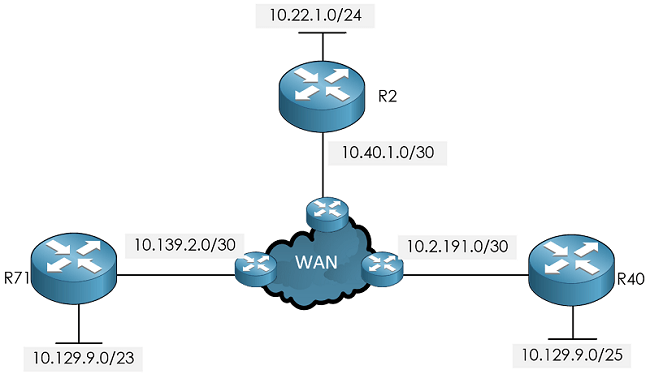
1. Refer to the exhibit. All routers in the network are configured correctly, and the expected routes are being exchanged among the routers. Which set of routes are learned from neighbors and installed on router 2?
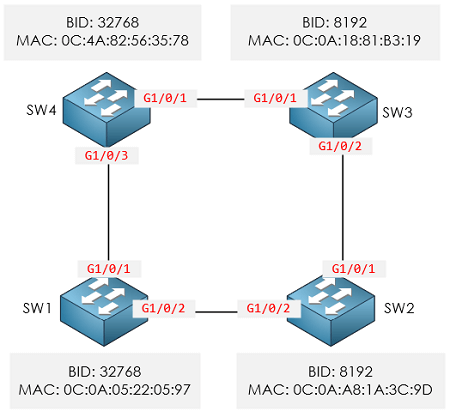
2. Refer to the exhibit. Which switch in this configuration will be elected as the root bridge?
A. SW1 B. SW2 C. SW3 D. SW4
3. Which two REST API status-code classes represent errors? (Choose two)
A. 1XX B. 2XX C. 3XX D. 4XX E. 5XX
4. Refer to the exhibit. Router R2 is configured with multiple routes to reach network 10.1.1.0/24 from router R1. Which path is chosen by router R2 to reach the destination network 10.1.1.0/24?
5. What are two benefits that the UDP protocol provide for application traffic? (Choose two.)
A. UDP traffic has lower overhead than TCP traffic B. UDP provides a built-in recovery mechanism to retransmit lost packets C. The CTL field in the UDP packet header enables a three-way handshake to establish the connection D. UDP maintains the connection state to provide more stable connections than TCP E. The application can use checksums to verify the integrity of application data
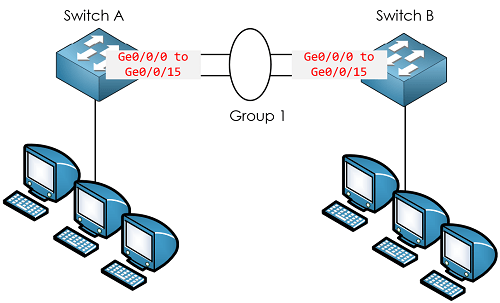
6. Refer to the exhibit. The LACP EtherChannel is configured, and the last change is to modify the interfaces on SwitchA to respond to packets received, but not to initiate negotiation. The interface range gigabitethernet0/0/0-15 command is entered. What must be configured next?
A. SwitchA(config-if-range)#channel-group 1 mode auto B. SwitchA(config-if-range)#channel-group 1 mode active C. SwitchA(config-if-range)#channel-group 1 mode desirable D. SwitchA(config-if-range)#channel-group 1 mode passive
7. Refer to the exhibit. How will the device handle a packet destined to IP address 100.100.100.100?
100.0.0.0/8 is variably subnetted, 4 subnets, 4 masks
R    100.0.0.0/8 [120/2] via 192.168.3.1, 00:00:13, Ethernet0/3
S    100.100.0.0/16 [1/0] via 192.168.4.1
D   100.100.100.0/24 [90/435200] via 192.168.2.1, 00:00:13, Ethernet0/2
O   100.100.100.100/32 [110/21] via 192.168.1.1, 00:05:57, Ethernet0/1
A. It will always prefer the static route over dynamic routes and choose the route S 100.100.0.0/16 [1/0] via 192.168.4.1 B. It will choose the route with the lowest metric, R 100.0.0.0/8 [120/2] via 192.168.3.1, 00:00:13, Ethernet0/3 C. It will choose the route with the highest metric, D 100.100.100.0/24 [90/435200] via 192.168.2.1, 00:00:13, Ethernet0/2 D. It will choose the route with the longest match, O 100.100.100.100/32 [110/21] via 192.168.1.1, 00:05:57, Ethernet0/1.
8. A network engineer is configuring a new router at a branch office. The router is connected to an upstream WAN network that allows the branch to communicate with the head office. The central time server with IP address 172.24.54.8 is located behind a firewall at the head office. Which command must the engineer configure so that the software clock of the new router synchronizes with the time server?
A. ntp server 172.24.54.8 B. ntp master 172.24.54.8 C. ntp peer 172.24.54.8 D. ntp client 172.24.54.8
9. What is the RFC 4627 default encoding for JSON text? (Choose two.)
A. UCS-2 B. GB18030 C. UTF-8 D. Hex
10. Refer to the exhibit. What is the cause of poor performance on router R19? (Choose two.)
R19#sh int fa0/0
FastEthernet0/0 is up, line protocol is up
Hardware is DEC21140, address is ca02.7788.0000 (bia ca02.7788.0000) Description: SALES_SUBNET
Internet address is 10.32.102.2/30
MTU 1500 bytes, BW 100000 kbit/sec, DLY 100 usec, reliability 255/255, txload 1/255, rxload 1/255
Encapsulation ARPA, loopback not set
Keepalive set (60 sec)
Full-duplex, 100Mb/s, 100BaseTX/FX
ARP type: ARPA, ARP Timeout 04:00:00
Last input 00:00:01, output 00:00:00, output hang never Last clearing of "show interface" counters never
Input queue: 0/300/0/0 (size/max/drops/flushes); Total output drops: 135298429
Queueing strategy: fifo
Output queue: 0/300 (size/max)
30 second input rate 0 bits/sec, 0 packets/sec 30 second output rate 0 bits/sec, 0 packets/sec 73310 packets input, 7101162 bytes
Received 73115 broadcasts (0 IP multicasts) 0 runts, 0 giants, 0 throttles
0 input errors, 4 CRC, 0 frame, 0 overrun, 0 ignored
0 watchdog
0 input packets with dribble condition detected
3927513096455 packets output, 14404034810952 bytes, 0 underruns
0 output errors, 11 collisions, 0 interface resets
0 unknown protocol drops
0 babbles, 0 late collision, 0 deferred
0 lost carrier, 0 no carrier
0 output buffer failures, 0 output buffers swapped out
A. Excessive collisions B. Excessive CRC errors C. Port oversubscription
Me es grato informarte que eh paso mi examen de certificación y en efecto el banco de preguntas fue de gran ayuda, pero sobre todo el entendimiento que con todas las clases del curso fueron cruciales para poder acreditar el examen, agradezco de antemano el apoyo mostrado en cada clase y las respuestas oportunas, sin duda a sido un gran viaje durante estos 5 años con sus cursos y sin duda nos prepararemos para el reto a futuro que será el CCNP, sin mas, gracias por todo el apoyo y tengan por seguro que siempre recomendare a networkgeeks para los compañeros y amigos interesados en el mundo de las redes.
Saludos y el mejor de mis deseos para ti y todo el team.
¡Muchas felicidades por el logro! … y somos nosotros los que agradecemos tus palabras, tu retroalimentación, y tus recomendaciones, nos alegra ser parte de tu desarrollo profesional. Como siempre esperamos tenerte en futuros entrenamientos, y gracias por confiar en nuestros materiales!
En esta oportunidad felicitamos a Braulio Alvarez de México por obtener su certificación CCNA. Les pasamos su comentario publicado en LinkedIn: «Con mucho entusiasmo quiero compartirles que el dia de ayer obtuve mi certificación de CCNA, me da mucha felicidad haber obtenido este logro y mas por el aprendizaje que obtuve durante el camino. Hoy cierro una etapa de aprendizaje y abro nuevas etapas de desarrollo y crecimiento profesional
También aprovecho este espacio para agradecer a Alvaro Moreira que imparte contenido de excelente calidad que ademas de prepararte para la certificación te hace adquirir un conocimiento amplio y completo en las redes.
Ánimos al resto.
Saludos cordiales.
Esta respuesta fue modificada hace 8 meses, 2 semanas por AlvaroM.
Claro que sí, comentarte que hemos complementado la imagen con un enlace de 100 Gigas en la parte inferior.
Te preguntan sobre qué camino se debe tomar para llegar al prefijo 192.168.1.0/24, y te dicen que el ancho de banda de referencia es de 100 Gbps. Recuerda que si hablamos de OSPF, el costo de una interface es igual al ancho de banda de referencia dividido entre el ancho de banda de la interface en bps. En este caso 100 Gbps es igual a 10^11.
Entonces:
Si estamos trabajando con interfaces 10 Gig, el costo de la interface OSPF de salida sería equivalente a (10^11)/(10^10) = 10,
Si estamos trabajando con interfaces 100 Gig, el costo de la interface OSPF de salida sería equivalente a (10^11)/(10^11) = 1
De acuerdo a lo anterior:
La opción A nos daría un costo total de: 10+1+1+10 = 22
La opción B nos daría un costo total de: 10+10+1 = 21
La opción C nos daría un costo total de: 10+10 = 20
La opción D nos daría un costo total de: 10+1+1+1+1 = 14
Como puedes apreciar, el camino más corto es a través de la opción D.
Espero que ahora quede claro.
Quedo atento!
Saludos! =)
Autor
Entradas
Viendo 15 entradas - de la 586 a la 600 (de un total de 631)