Banco de preguntas CCNP ENCOR 350-401 actualizado 16 de marzo 2026
Si ya estudiaste para tu examen de certificación y crees que dominas todos los temas, solo te queda practicar y practicar. Ponemos a tu disposición el banco de preguntas oficial. Respondiendo a estas preguntas, ten la certeza que conseguirás la certificación. Este banco de preguntas se actualiza de manera periódica.
NOTA: Accede a este contenido a través de la compra de la membresía anual, a través de la compra del curso CCNP ENCOR 350-401, o a través de una membresía mensual de 30 USD.
1272 preguntas Incluyen preguntas de laboratorio
Soporte incluido para cualquier duda que tengas
Precio de 30 USD/Mes
Preguntas
Las preguntas prácticas (simulaciones), pueden verlas en este curso: Laboratorios del examen CCNP ENCOR 350-401. Es importante que vean por lo menos la primera clase para analizar el formato de las preguntas.
1. What are two characteristics of Cisco SD-Access elements? (Choose two)
A. Fabric endpoints are connected directly to the border node B. The border node is required for communication between fabric and nonfabric devices C. The control plane node has the full RLOC-to-EID mapping database D. Traffic within the fabric always goes through the control plane node E. The border node has the full RLOC-to-EID mapping database
2. Refer to the exhibit. An engineer must assign an IP address of 192.168.1.1/24 to the GigabitEthemet1 interface. Which two commands must be added to the existing configuration to accomplish this task? (Choose two)
Current configuration: 142 bytes
vrf definition STAFF
!
!
interface GigabitEthernet1
vrf forwarding STAFF
no ip address
negotiation auto
no mop enabled
no mop sysid
end
A. Router(config-vrf)#address-family ipv6 B. Router(config-if)#ip address 192.168.1.1 255.255.255.0 C. Router(config-vrf)#ip address 192.168.1.1 255.255.255.0 D. Router(config-if)#address-family ipv4 E. Router(config-vrf)#address-family ipv4
3. What is the data policy in a Cisco SD-WAN deployment?
A. List of ordered statements that define node configurations and authentication used within the SD-WAN overlay B. Set of statements that defines how data is forwarded based on IP packet information and specific VPNs C. Detailed database mapping several kinds of addresses with their corresponding location D. Group of services tested to guarantee devices and links liveliness within the SD-WAN overlay
4. Which action resolves the EtherChannel issue between SW2 and SW3?
Switch2#show etherchannel summary
Flags:  D - down        P - in port-channel
        I - stand-alone s - suspended
        H - Hot-standby (LACP only)
        R - Layer3      S - Layer2
        U - in use      f - failed to allocate aggregator
        u - unsuitable for bundling
        w - waiting to be aggregated
        d - default port


Number of channel-groups in use: 1
Number of aggregators:           1

Group  Port-channel  Protocol    Ports
------+-------------+-----------+----------------------------------------------

1      Po1(SD)           PAgP   Gi0/0(I) Gi0/1(I)


Switch3#show etherchannel summary
Flags:  D - down        P - in port-channel
        I - stand-alone s - suspended
        H - Hot-standby (LACP only)
        R - Layer3      S - Layer2
        U - in use      f - failed to allocate aggregator
        u - unsuitable for bundling
        w - waiting to be aggregated
        d - default port


Number of channel-groups in use: 1
Number of aggregators:           1

Group  Port-channel  Protocol    Ports
------+-------------+-----------+----------------------------------------------

1      Po1(SD)           LACP   Gi0/0(I) Gi0/1(I)
A. Configure switchport mode trunk on SW2 B. Configure switchport nonegotiate on SW3 C. Configure channel-group 1 mode auto on both interfaces D. Configure channel-group 1 mode active on both interfaces
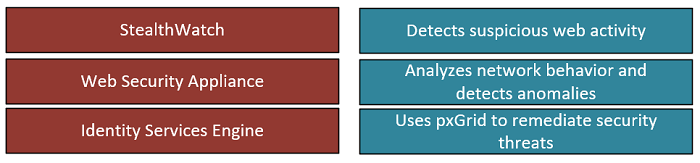
5. Drag and drop the solutions that comprise Cisco Cyber Threat Defense from the left onto the objectives they accomplish on the right.
6. Refer to the exhibit. A network engineer configures OSPF and reviews the router configuration. Which interface or interfaces are able to establish OSPF adjacency?
No hellos (passive interface)
Supports Link-local Signaling (LLS)
!  lines omitted for brevity
GigabitEthernet0/1 is up, line protocol is up
   Internet Address 72.16.30.1/24, Area 0, Attached via Network Statement
   Process ID 1, Router ID 72.16.11.29, Network Type BROADCAST, Cost:1
   Topology-MTID     Cost     Disabled     Shutdown    Topology Name
          0           1          no          no                 Base
Transmit Delay is 1 sec, State DR, Priority 1
Designated Router (ID) 172.16.11.29, Interface address 172.16.30.1
No backup designated router on this network
Timer intervals configured, Hello 10, Dead 40, Wait 40, Retransmit 5
  oob-resync timeout 40
  No Hellos (Passive Interface)
Supports Link-local Signaling (LLS)
!  lines omitted for brevity
GigabitEthernet0/0 is up, line protocol is up
   Internet Address 72.16.11.29/24, Area 0, Attached via Network Statement
   Process ID 1, Router ID 72.16.11.29, Network Type BROADCAST, Cost:1
   Topology-MTID     Cost     Disabled     Shutdown    Topology Name
          0           1          no          no                 Base
Transmit Delay is 1 sec, State DROTHER, Priority 1
Designated Router (ID) 172.16.11.27, Interface address 172.16.11.27
Backup Designated Router (ID) 172.16.11.30, Interface address 172.16.11.30
Timer intervals configured, Hello 10, Dead 40, Wait 40, Retransmit 5
  oob-resync timeout 40
  Hello due in 00:00:007
Supports Link-local Signaling (LLS)
! lines omitted for brevity
A. GigabitEthemet0/1 and GigabitEthernet0/1.40 B. Gigabit Ethernet0/0 and GigabitEthemet0/1 C. only GigabitEthernet0/0 D. only GigabitEthernet0/1
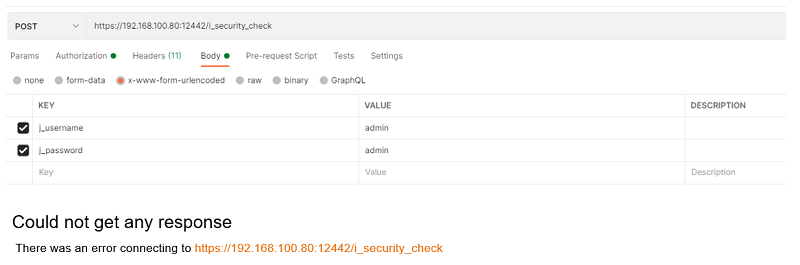
7. Refer to the exhibit. What step resolves the authentication issue?
Type       PROT  SYSTEM IP   ID        ID          PRIVATE IP                              PORT
PUBLIC IP                             PORT         LOCAL COLOR      PROXY STATE UPTIME      ID
----------------------------------------------------------------------------------------
vsmart dtls 0.0.0.0          100       1           192.168.100.80
12346 10.10.20.70                                    12446 default         No   up
0:02:24:09      0
vbond  dtls 0.0.0.0            0       0           192.168.100.81
12346 10.10.20.80                                    12346 default         -   up
0:02:24:10      0
vmanage  dtls 4.4.4.90       100       0           192.168.100.82
12346 10.10.20.90                                    12446 default
A. Restart the vsmart host B. Target 192.168.100.82 in the URI C. Change the port to 12446 D. Use basic authentication
8. Which encryption hashing algorithm does NTP use for authentication?
A. SSL B. AES256 C. AES128 D. MD5
9. What is a VPN in a Cisco SD-WAN deployment?
A. Virtual channel used to carry control plane information B. Attribute to identify a set of services offered in specific places in the SD-WAN fabric C. Common exchange point between two different services D. Virtualized environment that provides traffic isolation and segmentation in the SD-WAN fabric
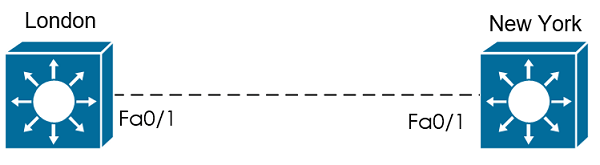
10. Refer to the exhibit. Communication between London and New York is down. Which command set must be applied to resolve this issue?
London(config)#interface fa0/1
London(config-if)#switchport trunk encapsulation dot1q
London(config-if)#switchport mode trunk

%LINEPROTO-5-UPDOWN: Line protocol on Interface FastEthernet0/1, changed state to down
%LINEPROTO-5-UPDOWN: Line protocol on Interface FastEthernet0/1, changed state to up

London(config-if)#end
NewYork#show dtp interface fa0/1
DTP information for FastEthernet0/1:
    TOS/TAS/TNS:                 ACCESS/AUTO/ACCESS
    TOT/TAT/TNT:                  NATIVE/ISL/NATIVE
Gracias por la observación, ya hemos corregido la respuesta, en realidad para la tarea 3, podría funcionar de cualquiera de las 2 formas:
R10(config)# ip route vrf CORP 10.101.2.0 255.255.255.0 tunnel0 ó
R10(config)# ip route vrf CORP 10.101.2.0 255.255.255.0 10.100.100.X
y para el otro router sería;
R20(config)# ip route vrf CORP 10.100.1.0 255.255.255.0 tunnel0 ó
R20(config)# ip route vrf CORP 10.100.1.0 255.255.255.0 10.100.100.X
Tal vez la primera forma sea la «más» correcta debido al enunciado que indica que «Solo debería utilizarse la interface tunnel0 para enrutar el tráfico»
Saludos! =)
Esta respuesta fue modificada hace 1 año, 12 meses por AlvaroM.